Street Names & Subtle Clues: What Your Address Says About Your Neighbourhood
Have you ever noticed how some homes sit on a Street, others on a Lane, Drive, or Boulevard—and wondered if those names actually mean anything?
They do… at least historically.
While modern development doesn’t always follow strict rules, roadway suffixes were originally chosen to describe how a road functioned, how traffic moved, and even the character of the surrounding homes. Understanding these distinctions can offer subtle insight into neighbourhood design, walkability, and lifestyle.
Consider this your practical guide to the meaning behind common street names—equal parts urban planning, real estate insight, and lighthearted trivia.
Street
A Street is traditionally found in urban or established neighbourhoods. Streets typically form part of a grid system, intersecting other streets at right angles and often lined with sidewalks, closely spaced homes, and local amenities.
If you live on a street, chances are you’re in a walkable area with neighbours nearby and easy access to shops, schools, or transit.
Road
A Road is one of the most flexible designations. It generally refers to a route that connects two places and often runs through suburban, rural, or mixed-use areas.
Roads may be long and winding, passing through farmland, residential pockets, or commercial zones. They’re less about symmetry and more about getting from Point A to Point B.
Avenue
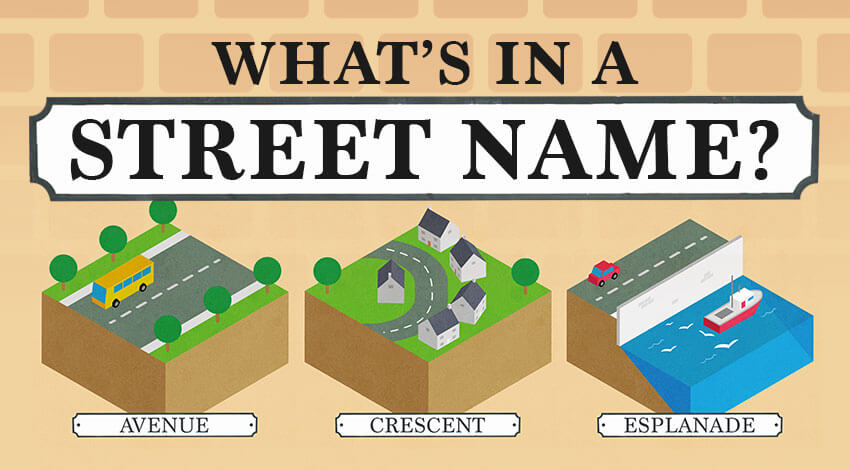
An Avenue is usually wider and more prominent than a street and often runs perpendicular to streets in a grid system. Many avenues are tree-lined and designed to act as a main corridor through a neighbourhood.
There’s often a sense of scale and structure to an avenue—it’s functional, visible, and frequently well-established.
Boulevard
A Boulevard is designed with impact in mind. These roads are wide, landscaped, and often divided by a median.
Boulevards are built to handle traffic while maintaining a polished, almost ceremonial feel. If a neighbourhood includes a boulevard, it’s often because planners wanted to create a strong first impression.
Lane
A Lane is typically narrower and more intimate. Found in suburban or rural settings, lanes often curve and feel quieter than larger roadways.
Homes on lanes tend to evoke a more relaxed, residential atmosphere—less traffic, more privacy, and a stronger sense of community.
Drive
A Drive usually follows the natural contours of the land rather than a rigid grid. These roads curve, rise, and dip, often offering scenic views or larger lots.
Living on a drive often means a quieter setting and a layout that feels more organic than structured.
Terrace
A Terrace is commonly built along elevated or sloped land. These roads may offer views, sunsets, or a sense of separation from lower-lying streets.
While the name suggests elegance, it can also mean hills—something worth noting for daily walks or winter driving.
Court
A Court is a short street that typically ends in a cul-de-sac. Courts are popular with families looking for minimal traffic and quieter surroundings.
With limited through traffic, courts often become natural gathering places for neighbours and children.
Place
A Place is usually a small, short road branching off a larger one. It’s designed to be low-traffic and residential.
Homes on places are often tucked away, offering privacy and a calm environment away from busier streets.
Way
A Way is similar to a place, but often even more subtle and hidden. These streets tend to branch quietly from main roads and feel distinctly residential.
If you like a tucked-away feel, a way often delivers exactly that.
Circle
A Circle is a looped road that connects back to itself or to a main road at two points. These are common in newer subdivisions and are known for reducing traffic flow.
Circles are popular with families, joggers, and anyone who appreciates a neighbourhood that feels contained and safe.
Alley
An Alley is a narrow lane typically located behind or between buildings. Historically used for deliveries and utilities, alleys today may provide parking access or service entry.
While not usually residential-facing, alleys play an important role in urban layout.
Crescent
A Crescent curves gently, often forming a semi-circle. These roads combine the quiet nature of a court with a slightly more extended layout.
Crescents tend to feel residential, calm, and thoughtfully designed.
Esplanade
An Esplanade is often found near water, parks, or open spaces. These roads are designed for scenic travel and leisurely walks.
If you live on an esplanade, views and outdoor enjoyment are usually part of the appeal.
Parkway
A Parkway is a wide, landscaped road built for smoother, more scenic driving. While homes may not front directly onto parkways, nearby properties often benefit from convenience and accessibility.
Despite the name, you drive on a parkway—it’s not for parking.
Trail
Originally referring to unpaved paths, a Trail in modern neighbourhoods is usually fully paved and residential. The name is meant to suggest nature and charm, even if wildlife sightings are optional.
Why This Matters in Real Estate
Street names alone don’t determine value—but they can offer helpful clues about traffic patterns, noise levels, walkability, and overall neighbourhood character.
At Modern Solution Realty, we look beyond the address to help buyers and sellers understand how location details impact lifestyle and long-term value.
If you’re considering buying, selling, or simply want a better understanding of your neighbourhood, expert local insight makes all the difference.
905-897-5000